The Rhetorical Foundations of Society by Ernesto Laclau
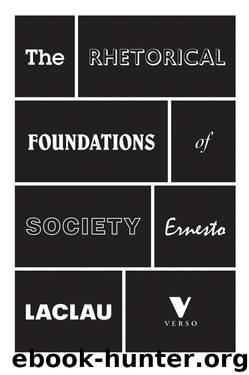
Author:Ernesto Laclau
Language: eng
Format: epub, mobi
Publisher: Verso Books
PRELIMINARY CONCLUSIONS
The Heideggerian Abgrund, the Lacanian objet a, and the Gramscian ‘hegemonic class’ show a similar ontological structure. In all three cases we have the ontological investment in an ontic object, and in all three cases the contingent character of this investment shows itself through its radical putting-itself-into-question: there is no ‘manifest destiny’ requiring that the ontological investment take place in that particular object. It is in that sense that the moment of the investment is constitutive: it cannot be explained by any underlying logic different from itself. It is for that reason that the abyss is also ground.
Thus, antagonism has a revelatory function. On the one hand, the moment of identitary institution transforms an ontic object into symbol of my possibility of being; but, on the other, the presence of the antagonistic force shows the contingent character of that identitary investment. Paradoxically, the internal structuration of the investment shows itself through that which interrupts and limits it. This interruption is decisive, and it is what makes the antagonistic relation non-assimilable to the other two logics that have tried to apprehend it – real opposition and dialectical contradiction – which, as we have seen, are entirely identitary logics that have no need to abandon a unified level of representation.
It is here that we can see all of the theoretical productivity of the old Husserlian distinction between sedimentation and reactivation – although giving to it a turn of which, no doubt, Husserl would not have approved. Sedimentation would be the strictly ontic moment of objects, when the contingent instance of their originary institution has been entirely concealed; reactivation would be the moment of return to that originary instance, to that contingent institution (not, as in Husserl, to a transcendental subject who would be a source of meaning). This means that the instituting act only shows itself in full through that which puts it into question. But this act of contingent institution, taking place in a field criss-crossed by the presence of antagonistic forces, is exactly what we understand by the political (in the ontological sense of the term, which has little to do with political organizations and structures, in their narrow meaning, which can perfectly well correspond to entirely sedimented practices). But, in that case, the field of a political ontology would also be the field of a general ontology.
There is a second aspect of this ontology that should be stressed. The three examples I have mentioned show a common feature: what is invested in an ontic particularity is a necessary dimension, but also an impossible one – an object lacking any direct form of representation. Investment consists precisely in transforming the ontic dimensions of the object in the expression or representation of something different from the object – that is, in an absent fullness. This means that that representation will always be figural or rhetorical. Rhetorical figures are thus endowed with an ontological value. Cicero asserted that we are forced to use rhetorical figures because there are more objects in the world to be named that the words our language provides.
Download
The Rhetorical Foundations of Society by Ernesto Laclau.mobi
This site does not store any files on its server. We only index and link to content provided by other sites. Please contact the content providers to delete copyright contents if any and email us, we'll remove relevant links or contents immediately.
| Anthropology | Archaeology |
| Philosophy | Politics & Government |
| Social Sciences | Sociology |
| Women's Studies |
The Secret History by Donna Tartt(19103)
The Social Justice Warrior Handbook by Lisa De Pasquale(12197)
Thirteen Reasons Why by Jay Asher(8919)
This Is How You Lose Her by Junot Diaz(6894)
Weapons of Math Destruction by Cathy O'Neil(6284)
Zero to One by Peter Thiel(5808)
Beartown by Fredrik Backman(5767)
The Myth of the Strong Leader by Archie Brown(5513)
The Fire Next Time by James Baldwin(5454)
How Democracies Die by Steven Levitsky & Daniel Ziblatt(5225)
Promise Me, Dad by Joe Biden(5157)
Stone's Rules by Roger Stone(5091)
A Higher Loyalty: Truth, Lies, and Leadership by James Comey(4966)
100 Deadly Skills by Clint Emerson(4931)
Rise and Kill First by Ronen Bergman(4797)
Secrecy World by Jake Bernstein(4756)
The David Icke Guide to the Global Conspiracy (and how to end it) by David Icke(4723)
The Farm by Tom Rob Smith(4517)
The Doomsday Machine by Daniel Ellsberg(4493)
